


THE SAAB SCANIA STORY 1891-1989
Founded in the autumn of 1891, the following year the Vagnfabriks-Aktiebolaget i Södertälje, a subsidiary of Surahammars Bruk, began production in a new 3,850-square-meter plant and built 1,739 railway carriages by the end of the century.
In 1897, however, wishing to diversify its production, the company commissioned Gustaf Erikson to develop the first Swedish automobile with an internal combustion engine. Toward the end of 1897, the engine was ready for its first bench test.
On August 25, 1897, Erikson signed the design for the car body.
The 1897 automobile, however, never managed to “run on its own” and was set aside until the spring of 1899, when it was dismantled.
Toward the end of the 19th century, the vast Kolmården forests in Sweden were invaded by nun moth larvae, and within three years as many as 3,000 hectares of forest were destroyed, leaving the owners with the problem of disposing of more than 400,000 tree trunks.
Since it was impossible to use horse-drawn vehicles to transport such an enormous quantity of timber from a practically untouched forest, it was decided to build a railway that would reach Bråviken, on the coast, and that would also serve for passenger transport in this remote region.
With the Stafsjö Railway in operation and construction of the line underway, Vagnfabriken received a request for a quotation to supply a bogie passenger coach.
The company’s design was based on a model previously supplied to an operator in the Jönköping area, with some modifications to the interior layout.
The finished coach was delivered on June 4, 1902.
In 1899, Vagnfabriken had 188 employees, 18 of whom were clerical staff.
Founded in Malmö at the beginning of the century, the Maskinfabriks aktiebolaget Scania in Malmö immediately began developing a prototype automobile.
The company’s first true production models (five in total), and the first in Sweden, rolled out in 1902–03.
Meanwhile, work continued at Vabis, and both companies built their first trucks.
The Malmö plant obtained its first export contract—from Russia.
Vabis continued to focus mainly on rolling stock, producing 1,298 railway carriages and wagons, 25 railcars, and 26 automobiles.
At the beginning of the 1890–1900 decade, the English bicycle manufacturer Humber established a Swedish subsidiary, Svenska Humber & Co., in Malmö.
In 1900, the company was taken over by a new Swedish firm, Maskinfabriks aktiebolaget Scania in Malmö, whose corporate charter was adopted on January 26, 1901.
The company’s trademark, registered on April 16 1901, marked the first appearance of the griffin, the legendary creature that still features in the Saab-Scania logo today.
Over time, the company expanded its production activities to include machinery for rubber manufacturing, vacuum cleaners, precision gears, and eventually automobiles.
Scania exhibited a motorcycle at the first Scandinavian Motor Show in Copenhagen in 1902, becoming the first Swedish company to market a factory-built motorized bicycle.
The following year, however, production of the model was discontinued.
Automobile development began immediately after the formation of Maskinfabriks aktiebolaget Scania in 1900, when the young engineer Reinhold Thorssin was commissioned to design a car suited to Swedish conditions.
Unlike its competitor, Vagnfabriken, the company chose to base its model on foreign examples and, at first, to purchase or manufacture under license certain essential components.
Scania built three prototypes in 1901 and 1902. Experts have long debated the order in which they were produced, and it has even been said that the third model was merely an evolution of the second—known as “Thorssin’s automobile”—which until recently was considered the first of the three.
However, the answer was provided by a discovered archive of design drawings.
The first drawing, number A1, indeed depicts the only surviving prototype.
Originally painted a light yellow color, it was affectionately nicknamed “The Yellow Peril.”
In September 1902, the third prototype — version no. 2 of Thorssin’s automobile, now equipped with a water-cooled engine — probably became the first Scania automobile to be delivered to a customer.
The history of Scania began in 1900 with the Vagnfabriks aktiebolaget i Södertälje, and in 1911 the Scania-Vabis company was created through the merger of Maskinfabriks aktiebolaget Scania and Vagnfabriks aktiebolaget i Södertälje.
It is not easy to identify the very first trucks built by the two companies whose merger led to the formation of Scania-Vabis.
Unfortunately, none of the earliest trucks have survived — which is not surprising given the limited number of vehicles produced in those years (probably no more than six by 1906).
By early 1902, work on truck design was clearly underway, while documents from the following September show another phase of intense activity.
No later drawings or other documents related to the first truck built by Scania in Malmö have been found.
It appears, however, that it was a 1.5-ton vehicle powered by a 12 hp, two-cylinder engine.
Meanwhile, development work continued intensively in Södertälje.
Since Vagnfabriken relied entirely on its railway carriage production, it was natural to consider the possibility of using Erikson’s engines in railway vehicles.
The first motorized railcar was therefore tested on August 8, 1902, and kept for further development.
Both the engine and the truck were apparently built in the summer of 1902, around the same time the railcar test was being prepared.
At the Stockholm Motor Show of 1903, the truck was offered for sale at 8,000 kronor, later advertised at 7,500 kronor, but failed to attract buyers.
It was only in the late summer of 1906 that the vehicle finally found a buyer.
In fact, the first truck built by Vagnfabriken was not the first to be sold, since the only model built in 1903/04 (a 2.5-ton vehicle, completed on July 15, 1904) was purchased about a month before the 1902 model.
For unknown reasons, this 1902 model remained unsold until May 5, 1906, when it was delivered to the St. Erik Brewery in Stockholm, the company’s first customer.
The Vagnfabriks-Aktiebolaget i Södertälje was a subsidiary of Surahammars Bruk, the long-established ironworks of Surahammar.
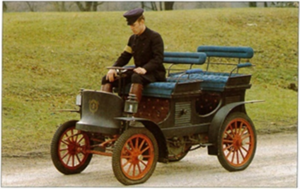
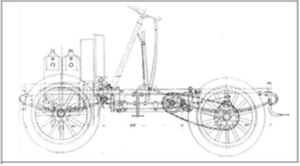
Since it was in Surahammar that Gustaf Erikson carried out his experimental work on the first Vabis automobiles, it is logical that the Surahammars Bruk Museum collection includes one of Vagnfabriken’s earliest products: a tonneau-bodied automobile built in 1903.
Although designed and built in Södertälje, this model is known as the “Surahammar automobile” because it was first used there as a means of transport; the ironworks bought it in August 1909.
The car apparently remained in service until 1913, when it was replaced by a new Scania-Vabis vehicle, but was later rediscovered in Spännarhyttan and meticulously restored.
The automobile was supposed to be exhibited in Stockholm in 1903, but it was not finished in time. After its first test run that summer, it was instead presented at the Exposition Internationale de l’Automobile, du Cycle et des Sports in Paris.
Toward the end of 1902, production began on an initial series of five automobiles (Scania Type A), applying the experience gained from the three prototypes built in 1901 and 1902.
One of the models was displayed at the Stockholm Motor Show of 1903, together with a variant of the Type A featuring a newly designed hood.
This latter model attracted considerable attention by covering the distance between Malmö and Stockholm in just 32 hours over the course of three days.
The buyer used the vehicle to transport both passengers and goods.
In fact, he had bought a *“combi”*! The rear seat could be removed and replaced with a platform for cargo, making this vehicle ideal for his business of producing, importing, and exporting pharmaceutical products.
Freight wagons were soon designed for the transport of minerals, coal, and timber; one of these was the two-axle open flat wagon with low hinged sides, used for products such as coal.
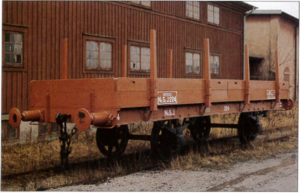
This type of wagon was also equipped with removable side stanchions to secure the large stacks of timber, which were among the most common loads transported by rail.
This wagon, known as No. 1, was built in numerous variants, including narrow-gauge versions, for the Swedish State Railways (SJ) and for private operators. By 1907, SJ owned more than 5,000 of them, accounting for about one fifth of its entire freight fleet.
Vagnfabriken built a total of 600 No. 1 wagons, of which 160 were for SJ.
Vabis 1909: this is the oldest surviving Vabis truck.
Its construction dates back to 1909, the same year it was sold to AB Reinhold Bergmark, a shoe factory in Gothenburg, for 10,500 kronor.
The truck, registration number 084, was equipped with a V-twin engine producing 15–18 horsepower. It was re-registered in 1916 under the number 035.
Vabis Car 1909
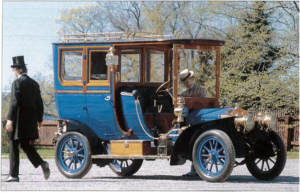
The oldest private Vabis automobile was delivered toward the end of 1909, after various complications. The Mjölkningsmaskin AB company of Stockholm finally received the Vabis automobile it had ordered many months earlier.
The vehicle was delivered on October 15, instead of July 15 as promised.
1910–1919:
During this decade, Scania-Vabis made significant progress in vehicle production, building a total of 1,147 vehicles, including 475 of the approximately 830 automobile chassis produced before this activity was suspended.
Exports represented the most notable aspect, with 25% of production sold abroad. The year 1911 marked the end of the railway era, after the construction of another 135 wagons and carriages, although a further 17 railcars were produced up until 1914.
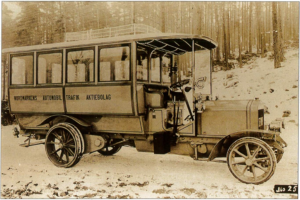
It is almost impossible to identify with absolute certainty the first bus built in Sweden. However, everything seems to indicate that the “Nordmark” was the first Swedish-made model to enter regular service.
Equipped with a chain-driven chassis built by Scania in Malmö, and with the engine and bodywork made by Vabis in Södertälje, the bus was delivered by Scania-Vabis to the Nordmarkens Automobiltrafik Aktiebolag on October 17, 1911.
On May 23, 1913, Scania-Vabis won the contract to supply the Royal Swedish Post Office in Stockholm with as many as 13 postal vans.
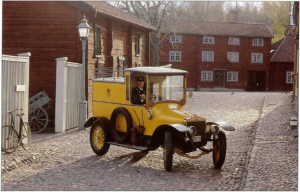
Of the thirteen vehicles, seven were of the type shown above. The body was mounted on a standard chassis from the newly introduced range of Scania-Vabis vehicles.
The previous year, the Gothenburg Post Office had purchased vehicles of the same type, and it was therefore Stockholm’s turn to modernize its fleet. In total, as many as twenty-five new vans of different models were ordered all at once.
Since the Stockholm Post Office did not have qualified drivers, Scania-Vabis undertook to provide the drivers and to carry out the necessary repairs — making it one of the first comprehensive service contracts ever signed in Sweden.
Scania-Vabis Type 1, 1914
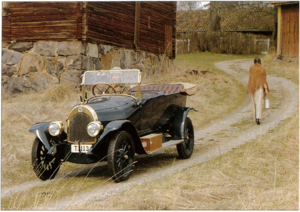
The Scania-Vabis Type I with torpedo body was delivered to the health officer A.G. Nyblin and his eighteen-year-old son, Sigvard, in Södertälje on November 6, 1914.
Scania-Vabis Fire Engines 1912–1919:
After receiving an order from the Municipality of Norrköping in 1912, Scania-Vabis delivered its very first fire engine, with a chassis built in Malmö and the engine and gearbox manufactured in Södertälje.
At the beginning of 1913, personnel had been trained in the use of the new equipment, which entered regular service and continued to perform reliably until it was decommissioned in 1950.
The second Scania-Vabis fire engine, delivered in 1914, also performed excellently, remaining in service until 1940.
The third unit, delivered on June 22, 1915, is still in excellent condition today.
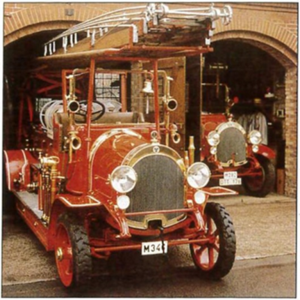
Of the five all-wheel-drive fire engines supplied to various Swedish services, only one remains — the one delivered on September 19, 1919, to the firefighters of Södertälje, where it remained in service for twenty-five years.
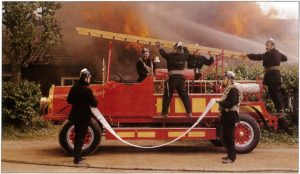
“‘The ideal car for the gentleman’ was the advertising slogan for the new Scania-Vabis Type I automobile, used by the sales representative Erik Hedlund during the First World War. The power of advertising was evident even then: the
first users of the new model, known today as ‘the Kiilarne car,’ were gentlemen from the Swedish Ministry of Defense.”
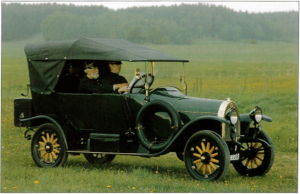
The 1916 Type I automobile with torpedo body was delivered in September 1917 to Lieutenant Colonel F.W. Lowenborg, the regional commander of Haparanda.
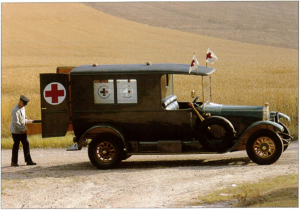
Scania-Vabis Automobile Chassis were used for various types of bodies, also produced in Södertälje. A special application was ambulances, built in versions capable of carrying anything from a single stretcher up to as many as eighteen stretchers! In the latter case, the vehicle was based on a motorized unit and equipped with two trailers, each transporting six patients.
The trucks built by Scania-Vabis during the first half of the 1910–20 decade were largely based on Scania models from before the merger of the two companies, and it was only later that they were replaced by more modern models. However, since the older chassis and engines were given new designations, it is difficult to trace the first Scania-Vabis trucks.
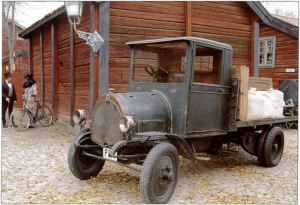
1920–1929
Following the increasing financial difficulties encountered toward the end of the 1910s, in 1921 Scania-Vabis went into liquidation, but was later restructured. With the Malmö plant closed and automobile production suspended, operations were concentrated in Södertälje.
During this decade, a total of 1,714 vehicles were built (427 of which were buses). The activity, however, proved unprofitable, resulting in losses for six of the ten years. Toward the end of the decade, one vehicle was being built per day, with a total workforce of four hundred employees.
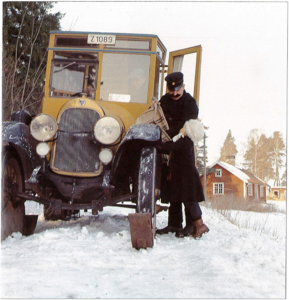
Postal Bus 1922:
Scania-Vabis postal buses ended the winter isolation of remote northern regions.
“Cars were built to operate both in summer and in winter, on snow-covered roads and during the thaw.”
The Postal Service, needing to deliver mail and transport passengers in sparsely populated areas, was particularly interested in finding a practical solution, and thus relied on its own expert, Ernst Nyberg.
Stimulated by the ingenuity of Julius Juhlin, Nyberg’s creativity resulted in fifteen functional postal buses, designed and built in close collaboration with Scania-Vabis in 1922–23.
The 36 HP engine transmitted power to the rear wheels via a four-speed gearbox, a driveshaft, and a rear axle with a double reduction.
This provided a total of eight gears, two of which were low-range gears for very high traction. Additionally, the other components were, so to speak, reinforced to withstand harsh winter conditions.
Scania-Vabis built the chassis, which was then transported to the Postal Service workshop in Ulvsunda, where the vehicle was completed under the direction of Ernst Nyberg. Although a bus body was used, the interior could be modified to dedicate one-third, two-thirds, or the entire vehicle to passenger transport (with a maximum of twelve seats), while the rest was reserved for goods. If necessary, a trailer could be attached for transporting mail and cargo.
Two of Nyberg’s inventions made the postal bus unique.
The first, a track transmission, was inspired by a Citroën desert vehicle, while the second provided a level of comfort few vehicles of the era could boast: fresh air heated by the exhaust system was used to warm the passenger compartment.
The track transmission, remarkable both for its ingenuity and performance, deserves closer examination.
Two auxiliary rear axles (each fitted with pulleys) were mounted—one in front and one behind the normal axle—easy to attach and remove depending on conditions.
Wide rubber tracks ran around the rear wheels and the auxiliary pulleys, providing excellent grip in the snow, while the front wheels were fitted with skis in winter. The ground load was therefore significantly reduced, preventing the bus from sinking into powdery snow.
Nyberg added further improvements. For example, the driver could adjust the auxiliary axles longitudinally and vertically to vary track tension according to terrain conditions.
Snow-related problems were effectively solved; not even half a meter of snow could stop the bus.
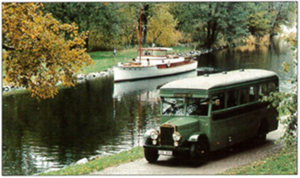
The “Vitesse” was an elegant classic line vessel made of mahogany, dating back to the late 1910s. Originally used by Scania-Vabis as a test boat and to entertain potential clients, it was later sold due to the financial difficulties of the 1920s.
In 1927, it was transformed into a postal bus, also used as a military postal bus, becoming the exceptional vehicle that Scania has been using almost daily since the 1980s to transport VIPs to its Södertälje plant. The bus proudly bears the name “Noblesse.”
The relationship between the two means of transport is evident: both have the same luxurious mahogany and plush interiors, and are finished with the same precision and attention to detail. Undoubtedly the only one of its kind in the world, the “Noblesse” is not only a beautiful vehicle but also a very comfortable one.
From the very beginning, however, the company’s position in the automobile and light truck sector—where there was a large influx of low-priced imports—was rather fragile, while truck and car chassis were also used for buses.
Attempting to compete would have been unwise, according to the company’s executives.
In 1925, it was decided to suspend automobile production and instead focus on a new generation of heavy trucks (over 2 tons), a sector in which the company had better prospects for success. The “Veloce” truck was a success, while car production ceased almost immediately, with the last models built in 1929.
During that period, Scania-Vabis developed a series of new engines that conquered the market, soon becoming renowned for their durability and economy. From that moment on, engine technology would contribute significantly to Scania-Vabis’s competitiveness a role it continues to play today.
In the second half of the 1920s, there was a remarkable, entirely unexpected development in the bus sector. Lindmark and Nilsson, however, managed not only to keep up with technological advances but, in some respects, to be at the forefront. The new bus with progressive suspension, introduced in 1923, was highly appreciated by both operators and passengers. Its smoother operation meant that far fewer components came loose due to jolts and caused problems, and for the first time, travel was truly comfortable.
Truck and bus production had been coordinated to the extent that the same transmission components were used.
A new important customer, the Swedish State Railways (SJ), followed the developments in the bus market with interest. Despite its name, SJ had managed a limited number of bus services since 1911, mainly in rural areas not
served by rail. Although SJ’s fleet consisted exclusively of imported brands (including Daimler, Mercedes, and MAN), Scania-Vabis offered numerous features so attractive that SJ decided to test its capabilities by purchasing a Swedish product and ordered its seventh bus from the Swedish company.
This marked the beginning of a massive expansion of provincial bus services, offered both by independent operators and SJ. The bus soon became an efficient and versatile means of transport throughout the country, complementing the railway.
Towards the end of the 1920s, Sten Simonsson, director of the Södertälje brewery, and Per Lindmark, CEO of Scania-Vabis, were often travel companions on the train to Stockholm; it is said that it was during one of these trips that the contract for the supply of a new 2.5-ton truck, Type 3251, was negotiated.
The new vehicle was initially used to transport raw materials from the barges at the port of Södertälje to the factory. A few years later, it was used for deliveries, operating within a 50-kilometer radius—a rather risky task, since drivers were provided with free beer…
By the end of the 1920s, Scania-Vabis’s automobile production was nothing more than a memory.
After the forced liquidation of the original Scania-Vabis in 1921, the company’s new management undertook a vast modernization program, which included, among other things, the suspension of car production in 1925. Existing parts and components were still used, and another 52 vehicles were built between 1926 and 1929, when the automobile era came to a definitive end.
Total production, including Erikson’s car, amounted to around 830 automobiles and other vehicles based on automobile chassis.
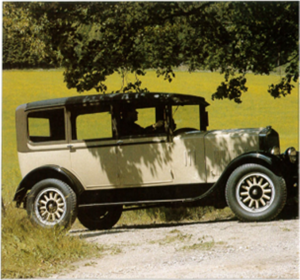
Of interesting construction, the latest automobile could appropriately be described as a model made from spare parts, as most of its components were in fact surplus from the warehouse. It was, however, based on a Type chassis of the same kind as the “Nyblin.”
The “Kiilarne” was longer than the original model and had a modified suspension. The 1929 automobile was a four-door model, with a covered body built only for this model and its companion (the Type I was normally a torpedo).
Unlike the Type I, the gear lever was in the center rather than on the outside right of the body.
1930–1939
In this decade, Scania-Vabis gained greater prominence as a bus manufacturer, producing 1,602 buses and 970 trucks. This development was due, among other things, to the introduction of the new “Bulldog” forward-control bus. Gasoline engines, replaced in the 1930s first by the Hesselman engine and later by a true diesel, were in decline. Towards the end of the decade, the approach of war jeopardized Swedish fuel supplies.
In its first five decades, the company had built 830 automobile chassis, 2,614 trucks, 2,032 buses, and 1,340 separate engines.
The first specimen of the new Scania-Vabis bus (Type 8305) entered service among the Mälaren islands, near Stockholm, in January 1932, followed in April by the Type 8307 (5 cm wider) and immediately met with great success. Extremely spacious for its length and wheelbase, no fewer than fifty-five were sold before the end of the year.
Nicknamed by the public the “Bulldog” (a name immediately adopted by Scania-Vabis and the rest of the industry), it marked the advent of the fully forward-control bus, a concept that is now universal.
Most of the trucks built by Scania-Vabis in the 1930s were intended for road management authorities and private companies engaged in road maintenance, snow clearing, and similar work.
One of these vehicles was known by the nickname “Sorsjön,” after the locality in Dalarna where its owner, Ivar D. Mattson, lived. Delivered in October 1934, this truck was one of the eighty-two built that year by Scania-Vabis.
In the 1930s, the only Swedish aircraft industry was located in Linköping. It was a small specialized division of the Swedish Railway Workshops (Aktiebolaget Svenska Järnvägsverkstäderna, ASJ).
As the winds of war swept across Europe, Sweden needed to strengthen its military capabilities by creating its own aircraft industry capable of producing military planes for the armed forces.
In April 1937, Svenska Aeroplan Aktiebolaget, abbreviated as SAAB, was founded, with headquarters in Trollhättan, where all SAAB’s activities were initially concentrated.
In 1938, SAAB obtained a license to build the medium-heavy bomber Junkers Ju86K (B3) and began aircraft production.
The first Swedish-built B3 bomber was produced in Trollhättan just a few weeks after the outbreak of war on September 1, 1939.
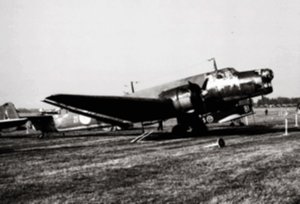
The initial order from the Swedish government called for the delivery of 16 heavy bombers B3 (JU86 built under license), 102 light bombers B5 (Northrop 8A1), 260 P7 bombers (B17), 88 to 140 P8 bombers (B18) and 200 NA-16-4M training aircraft (Sk14 built under license)
In addition, having completed the construction and flight testing of a new fighter (the J21) and a new bomber, SAAB was required to deliver 210 and 176 units of each type respectively, within 33 months of the administration’s order.
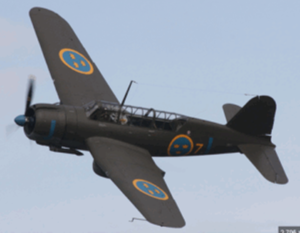
SAAB developed the S17, produced in 322 units, designated either S17 or B17, depending on its role (S stood for reconnaissance and B for bomber in Swedish).
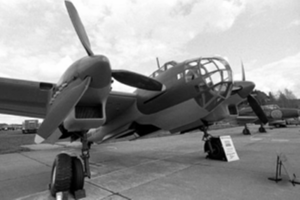
At the beginning of 1939, SAAB began designing the Saab 18 bomber, which was intended to replace the B3.
1940–1949
At the beginning of the war, in 1939, Scania-Vabis’s production capacity was 300 vehicles per year.
By the end of the war, this capacity had multiplied thanks to a series of large military orders (for a total of 1,037 vehicles) and an expansion program carried out despite the difficulties of the wartime period.
The company took on the general representation in Sweden of Volkswagen and Willys Overland, and the national distribution network was expanded.
Meanwhile, exports also began to increase.
In 1946, Scania-Vabis’s vehicle production exceeded 1,000 units for the first time, while 1947 was the last year in which more buses than trucks were built.
Having started the decade with 940 employees, the company ended it with more than 2,000.
When the war broke out, Scania-Vabis was in the process of switching to diesel production. Having built its first diesel engine in 1936, the company was then producing its “unit” engines with four, six, and eight cylinders (D400, D600, and D800), which had to be converted to run on producer gas.
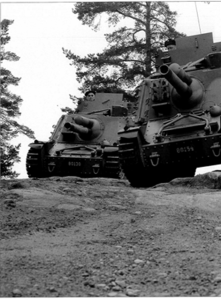
Two armored vehicles were built for the Swedish Army. The SKP — where “S” stood for Scania-Vabis, “K” for kaross (bodywork), and “P” for pansar (armored).
In 1941, designs for the J21 interceptor and attack aircraft were presented. It made its maiden flight on July 30, 1943, and was one of the first aircraft ever equipped with an ejection seat, since the propeller posed a danger if the pilot had to abandon the aircraft.
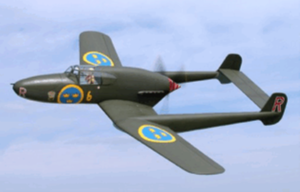
the first operational aircraft was delivered on December 1, 1945.
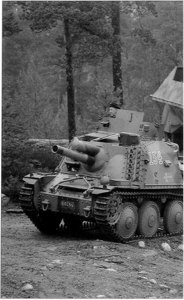
On March 2, 1943, Scania-Vabis received an order for a new type of vehicle for the Swedish Armed Forces: an artillery support vehicle consisting of a cannon mounted on a tank chassis. During the early years of World War II, other European armies had adopted similar vehicles with considerable success.
The army commissioned Scania-Vabis to modify a prototype of the m/41 tank to carry a 75 mm cannon. (Later, a 105 mm gun was installed instead.)
The project, which cost 36,000 kronor, was a success, and in March 1944 a contract was signed for the supply of eighteen SAV m/43 vehicles (as this model was designated), which were delivered between November 1944 and January 1945.
Another eighteen SAVs were ordered toward the end of 1945.
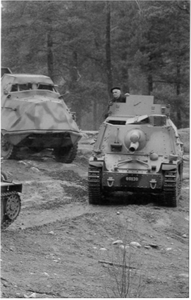
Like the first series, these were also based on the chassis of the m/41 tank, whose origins were quite interesting.
Ninety of these had been ordered in 1940 by the Swedish Army from a Czechoslovak manufacturer, but delivery was blocked by the Germans, who were occupying Czechoslovakia at the time.
The army, however, eventually received its tanks after persuading the Germans in 1941 to allow Scania-Vabis to build them under license in Sweden. In total, 220 m/41s were produced.
Scania-Vabis delivered the last of these vehicles on November 11, 1947, and the SAV took part in military maneuvers for the last time in 1968.
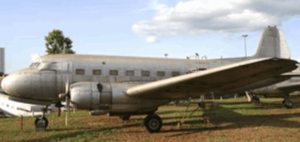
In 1944, two new projects began the Saab 90 Scandia, a twin-engine airliner
and the Saab 91 Safir, a trainer aircraft
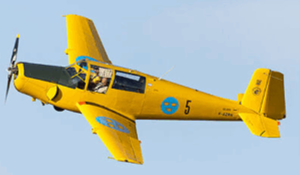
As the end of the war approached, SAAB realized that military contracts would no longer be sufficient to keep its specialized workforce employed.
So, in 1946, the idea of building a front-wheel-drive, two-stroke car costing about 3,200 Swedish kronor ($1,100) was proposed. An annual production of 2,500 to 3,000 cars would absorb the production capacity of the Trollhättan plant.
Development of the car took place in Linköping, led by engineer Gunnar Ljungström with a team of about 20 people.
Since SAAB had no experience or tradition in car manufacturing, it relied on the common sense and technical, analytical, and innovative thinking of its personnel.
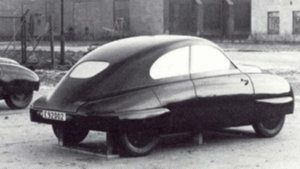
The first prototype, the original Saab 92001 (Ursaab), was neither aesthetically pleasing nor very practical.
Sixten Sason, then working with SAAB on technical drawings and aircraft radiography, was identified as the right person for the job.
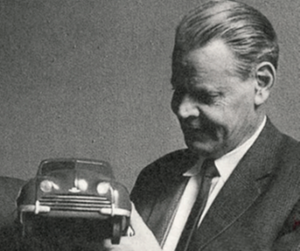
Thus, on June 10, 1947, the first prototype of the 92002 model was presented to the Swedish public.
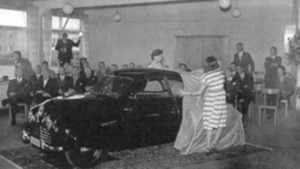
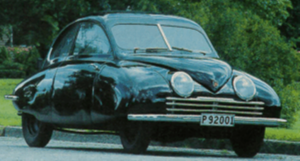
The declared top speed was 100 km/h, and the car was equipped with a 25-hp two-stroke twin-cylinder engine, mounted transversely.
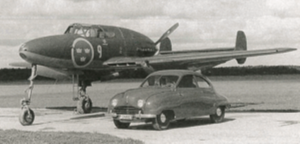
Its shape was very advanced for the time and clearly inspired by aeronautical design.
With his design for the 92002, Sason introduced a style that would characterize Saab cars for the next thirty years.
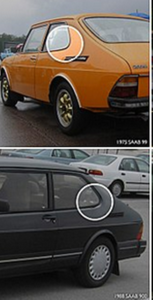
The car featured the “Saab hockey stick”, the nickname for the distinctive design of the C-pillar and the lower edge of the rear window, resembling the shape of an ice hockey stick.
This became a stylistic hallmark adopted in most Saab vehicles and continued in later models.
In 1953, the Saab 92B was introduced, easily recognized by its larger rear window, the fuel cap positioned on the rear fender, and a trunk lid that allowed access from the outside.
All Saab cars had abandoned the original bottle-green color by then.
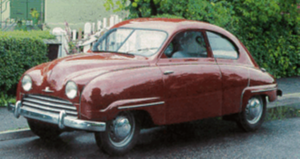
In the 1950s, the Armed Forces had purchased large quantities of cellulose-based green paint for camouflage.
However, the color proved unsuitable for Sweden’s forest green landscape (the equipment became easier to spot), and the paint was sold to Saab, who used it for a period on their vehicles.
However, the Saab 92 suffered from several shortcomings.
It lacked a proper trunk, so luggage had to be loaded from the back seat it had poor rear visibility, the engine tended to overheat.
Saab owners were known for their patience. A book about the brand included this quote:
“Saab drivers saw themselves as an elite, stoically enduring the remarks of less enthusiastic motorists about its chugging, smoke, and poor rear visibility.”
In 1946, the first version of the L10 truck was introduced.
The first version of the L10, with a gross weight of 8.5 tons, was a very versatile unit. Together with its successor, the 2L10 model, almost 1,300 units were built.
The L10 also had a gross weight of 8.5 tons, but this was increased to 9 tons with the introduction of a new front axle, new front springs, and stronger auxiliary rear springs. (The growing demand for higher payloads was already being felt.)
Among the new features were power-assisted brakes and, from 1948 onward, the option of an auxiliary gearbox that doubled the number of available gears.
The L10 was the first series of Scania-Vabis trucks to have left-hand drive; all previous models had right-hand steering.
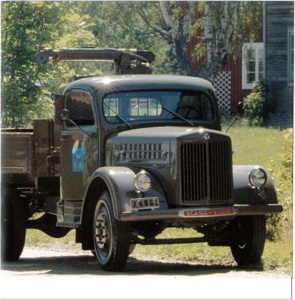
With a gross weight of 8.5 tons and a payload of 4.3 tons, this 1947 Scania-Vabis 2L12 was equipped with a 90 hp four-cylinder diesel engine with prechamber combustion.
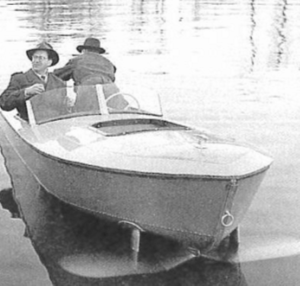
In 1947, Saab also ventured into a completely new field by producing 250 aluminum rowboats, some of which were sold in Africa.
They also developed a prototype hydrofoil, which never entered production.
The Saab J29 “Tunnan” (or “Flying Barrel”) made its maiden flight on September 1, 1948.
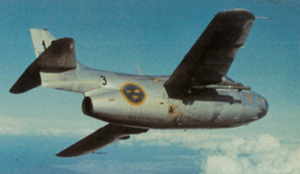
It was an interceptor and reconnaissance aircraft.
The pilot sat above the air intake like a rider on a horse, with the structure completed by a fuselage boom and tail section.
Its swept wings were a novelty for a European fighter.
It became one of the best aircraft ever built by Saab.
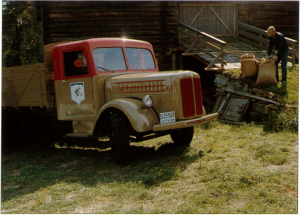
In 1948, the Scania-Vabis LS23 (1947–1949) appeared.
With a gross weight of 11.4 tons, the truck had a payload capacity of 6 tons.
Driving a Saab 92, K.G. Svedberg won the Circuit of Östergötland Endurance Rally in December 1949, the same month the model went into production.
Just a month later, two Saabs entered the prestigious Monte Carlo Rally.
Greta Molander and Rolf Mellde earned Saab some of its first motorsport victories.
Driven by Svedberg / Rolf Mellde and Greta Molander / Margareta von Essen, the cars (chassis numbers 7 and 8) finished 69th and 55th, respectively.
Among the co-drivers of legendary rally driver Erik Carlsson was Mario Pavoni, a Swedish of clearly Italian origin, who partnered with him in several rallies between 1957 and 1961.
1950–1959
For Scania-Vabis, the opening of borders marked the beginning of industrial operations abroad, with the establishment of an engine manufacturing plant in Brazil.
An export department was created. No less than 43,7% of the production from this decade was exported, and for the first time, in a single year (1952), more than a thousand vehicles were sold abroad.
In 1958, bus production reached one thousand units.
Sales of VW vehicles increased, with 184,111 vehicles sold during the decade.
The number of employees doubled again, reaching about 4,000.
From a technical point of view, Scania-Vabis made a significant step forward with the introduction, in 1949, of its new Series 40 and 60 trucks; the fuel consumption of the new direct-injection diesel engine was 20–25% lower than that of the pre-chamber version. Moreover, the durability of the new Scania-
Vabis model quickly earned it the reputation of being a “400,000-kilometer engine.”
The prototype had been tested two years earlier, and shortly after, it underwent practical trials on a vehicle operated 24 hours a day.
In January 1948, two engines were tested on the road under normal traffic conditions, and the unit entered production towards the end of 1949.
The new engine featured a smaller combustion chamber than the pre-chamber diesel. The fuel was injected directly into the cylinders through the four holes of the injector, ensuring efficient combustion and greater fuel economy.
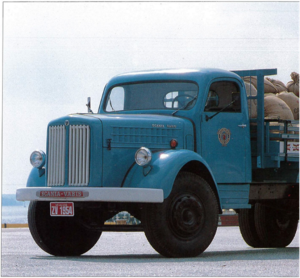
The Series 60 models were initially equipped with a four-speed gearbox, which, as was common at the time, was non-synchronized. An optional two-speed auxiliary gearbox was available, giving a total of eight forward gears.
The five-speed synchronized gearbox, introduced by Scania-Vabis in 1951, was a real breakthrough in the truck industry. Since the first gear of the new gearbox was lower than that of the four-speed version, the truck had greater pulling power.
In one version of the gearbox, the fifth gear served as an overdrive, further improving fuel economy.
The first truck sold by Scania-Vabis in Brazi was likely the L65.
Although two other trucks had been shipped to Brazil in 1948 and 1949, the L65 was probably the first to be actually sold.
The year was 1951.
A total of 3,939 units of the L60 series and 1,124 units of the LS60 series were built.
The Saab 32 Lansen, an attack and reconnaissance interceptor, had its prototype’s maiden flight on November 3, 1952.
It was a truly impressive high-tech aircraft.
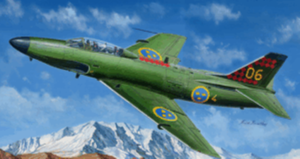
On October 25, 1953, the 32A became the first Swedish-built aircraft to break the sound barrier, making Sweden thefifth country in the world to achieve this important milestone.
On May 6, 1954, the J29 set a world record: piloted by Captain Anders Westerlund of the Uppland Wing, the aircraft reached an average speed of 977 km/h (607 mph) over a 500 km (311 mile) circuit.
The aircraft was a standard, unmodified J29.
The previous record of 950 km/h (590 mph) was held by a U.S. F86 Sabre.
In March 1955, the “Flying Barrel” set another world speed record, this time for aircraft flying in pairs over a 1,000 km (621 mile) circuit.
The reconnaissance version S29C reached an average speed of 900.6 km/h (559.6 mph), surpassing the previous 1950 record of 822 km/h (510.8 mph) set by a Gloster Meteor Mk 8.
The Scania-Vabis Metropol was the result of a joint venture with the American Mack Manufacturing Corporation, a project that would prove advantageous to both companies for many years.
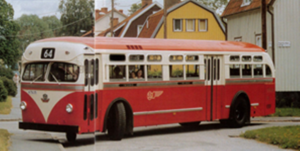
The project began with a business trip to the United States in 1948 by a team of experts from the Stockholm Tram Company.
During the visit, they were shown a test drive of the first in a new generation of buses built for the New York public transport service.
Capable of carrying 135 passengers (50 seated), this bus was considered ideal for Stockholm.
It had wide doors, making boarding and alighting easier, and its powerful 200 hp engine drove a fully automatic hydraulic transmission.
Other features included power steering, a tighter turning radius than usual, and a new, higher-capacity heating and ventilation system. The Stockholm tram company, highly impressed, asked the Swedish manufacturers if they could supply a similar model.
Following this request, the following year Scania-Vabis engineers traveled to America to study the U.S. system.
Like the Stockholm tram company, they found that Mack had an excellent reputation and built extremely reliable buses. Mack had also secured the New York City contract, even though its model was heavier than its competitors.
There was no time to waste: the Stockholm tram company’s schedule was so tight that Scania-Vabis did not have time to develop its own model, and the idea of a collaboration with Mack was proposed.
The managing director, Carl-Berthel Nathhorst, traveled to the United States where, on April 10, 1949, he signed a licensing agreement granting Scania-Vabis the exclusive production rights for the Mack C50 in Europe and sales rights worldwide, except in the United States.
The Scania-Vabis Metropol, introduced on Stockholm’s streets in the early 1950s, remained in service until 1967, the year Sweden switched to right-hand traffic. It quickly became a familiar sight in the city with its distinctive design.
Between 1953 and 1954, Scania-Vabis built 200 Metropol buses, 199 of which were for the Stockholm tram company. Although this model (like the Mack on which it was based) was exceptionally sturdy and durable, production was discontinued, mainly because the vehicle was too large for Swedish streets.
However, the company was already planning a smaller version, the Capitol, for city traffic.
During the 1950s, there was a rapid increase in truck payloads, from the former 3–4 tons to the more common 5–6 tons.
Meanwhile, Scania-Vabis was engaged in intense development to meet the growing demand for heavy trucks. The transition from pre-chamber engines to
direct injection, with the L40/60 series, marked a major technological advance in heavy truck engines in terms of economy, power, and durability. Nevertheless, the market was already demanding even more powerful engines and further innovations.
The L51 Drabant, which entered production in 1953, was the first of a new generation of vehicles to come out of the Södertälje plant.
Over the next six years, production of the Drabant reached 9,067 units, making it the company’s first true mass-production model.
Compared to its predecessor, the L40, the four-cylinder diesel engine of the L51 had its power increased from 90 to 100 hp, while gross weight rose from 9.5 to 10–11.5 tons. With a payload of 5.5–6.5 tons, the Drabant was ideal for most medium-heavy transport operations in the over-5-ton category, which was of greatest interest at the time.
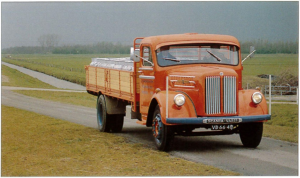
In the 1950s, truck technology made great progress.
Diesel engines, considered Scania-Vabis’s salvation, were continuously improved, while the popular L60/LS60 models marked the beginning of the long-haul transport era.
In 1954, the company introduced the L71/LS71 series (also known as the Regent), featuring more powerful engines and new design features.
The Regent was custom-built for heavy long-distance transport, as well as construction and timber hauling.
The six-cylinder inline diesel engine had its rated output increased to 150 hp.
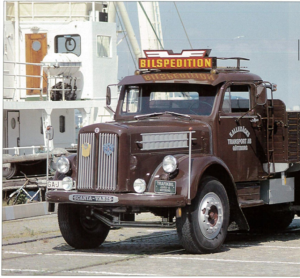
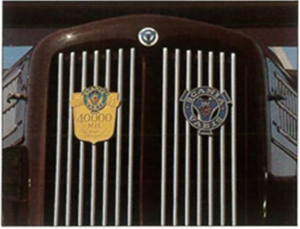
Meanwhile, the engine’s reliability was further improved, and it soon became common for trucks to cover 400,000 kilometers without an engine overhaul, which drew considerable attention in the 1950s.
The “400,000-kilometer engine” badge was discontinued, since this level of durability was no longer exceptional—it had become standard.
Advances in direct injection technology reduced fuel consumption, and Scania-Vabis advertising promised “minimum fuel consumption” for the L71, adding that it would be unnecessary to add oil between oil changes.
Brochures from 1954 offered the Regent in three colors: Scania Gray, light gray, and dark green, with radiators finished in red, blue, or cream. The era of exclusive finishes was still a long way off!
Between 1954 and 1958, when the next development phase was approaching, more than 7,700 L71 and LS71 units were built in total.
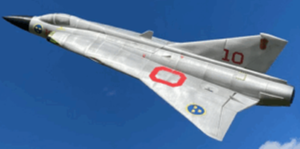
Meanwhile, development of a new supersonic aircraft had reached the first prototype flight stage: the 35 Draken, which would later be equipped with Saab RB05 attack missiles.
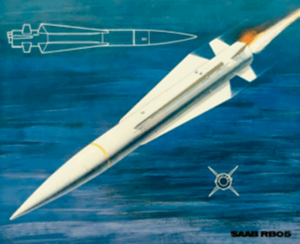
The inaugural flight of the first production Draken was scheduled for February 15, 1958.
On December 1, 1955, the Saab 93 was launched.
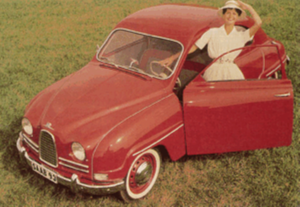
It had a longitudinally mounted 3-cylinder 33 hp engine, which offered more power despite a smaller displacement of 748 cm³.
The car debuted in the U.S. at the Great American Mountain Rally in 1956, where Saab entered three cars and won all overall, class, and team prizes.
The 1958 model, known as the 93B, was the first to feature a significant number of new enhancements, mainly to improve safety and performance. An upgraded version called the GT750 was specifically designed for the U.S. market, targeting buyers interested in a sportier and more luxurious version of the standard 93.
The most significant upgrade was to the engine, modified to deliver 12 additional horsepower. Of the 600 GT750 units produced, 546 were sold in the United States.
“Monster” was a stripped-down version with a 1.5-liter output achieved through two 748 cm³ engines.
The car was built to break the world speed record.
Although the attempt was technically successful (the car reached 198 km/h or 123 mph), the organizers forgot to appoint official record validators, and since the run was completed in only one direction, it was not recognized as an official record.
A final attempt ended with a transmission failure.
The twin-engine experimental car is now displayed at the Saab Museum in Trollhättan.
Saab cars were available with the optional ‘Saxomat’ clutch before the advent of automatic transmissions.
This system was controlled by a switch on the gear lever, requiring only the brake and accelerator pedals.
A separate lever was used to engage or disengage the freewheel.
In 1954, Scania-Vabis engineers began developing a “pure” BF bus model.
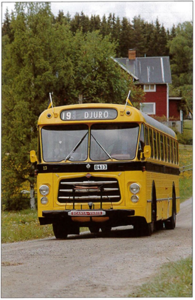
This was introduced in 1956 under the name BF73, where the letters indicated that it was an “intermediate” model, pending the D10 engine that would appear with the 75 series in 1959.
The BF73 introduced many innovations that paved the way for the front-engine chassis later introduced by Scania-Vabis.
The chassis was further refined.
It had a low-line design (which in itself was not new) and featured extensions of the crossmembers that protruded from the side members.
Whereas in the past coachbuilders had installed their own crossmembers on the chassis to support the body, now the floor could be mounted directly onto the chassis.
Moreover, the chassis had been “cleaned up” so that any type of bodywork could be fitted.
The BF73 was the first Scania-Vabis bus with a front-mounted engine equipped with power steering, which was essential due to the heavy front axle load. A large maximum steering angle, pneumatic brakes, and a synchronized gearbox made it safe and easy to drive, compensating for the fact that the driver also had to act as the ticket collector.
The BF73 quickly became the dominant model among front-engined buses.
Despite comments about its maneuverability, the Scania-Vabis Metropol was more suitable for the wide, straight American-style avenues and Swedish suburbs, but it was too large for city traffic.
At least, that was the opinion of Swedish authorities, who argued that the heavy axles damaged roads and bridges.
It was therefore not surprising that the Stockholm Tramway Company (SS) decided to explore the possibility of acquiring a new, smaller bus in the very year (1953) that the Metropol entered production.
The axle load was not to exceed 8 tonnes, and the maximum permitted gross weight was 14 tonnes.
Scania-Vabis submitted a proposal for a shorter, “Swedish” version of the Metropol with a six-cylinder engine, as well as a lighter variant of the same model featuring, among other things, slightly lighter axles.
The first deliveries were to be made only ten months after the order!
In September 1954, SS ordered a series of 180 buses of the lighter type, named Scania-Vabis C70 Capitol.
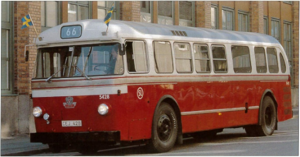
The Capitol was later improved with minor external modifications.
In 1959, the C75 made its debut — a version equipped with full air suspension as an alternative to leaf springs, and featuring Scania-Vabis’s new six-cylinder D10 engine.
The air suspension was revolutionary, not only in terms of ride comfort; in practice, the chassis components and the bodywork also benefited from the smoother ride, an advantage that was later exploited to significantly reduce weight.
The next stage, represented by the C76, a model with standard air suspension and the more powerful D11 engine, was introduced in 963.
In total, 429 Capitol buses were built.
In the mid-1950s, the first electronic computers designed for technical calculations were developed.
These digital machines were so large that they took up entire offices.
By the late 1950s, Saab began developing an onboard computer (originally called a “tactical calculator”).
The Saab D2 computer
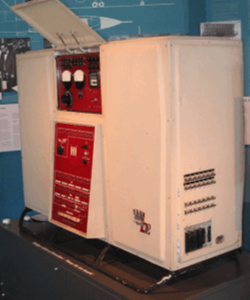
weighed 150 kg,housed around 6,000 transistors and could perform 40,000 operations per second, making it the fastest computer in Europe at the time.
For internal use, Saab installed the first computer designed solely for industrial purposes, a giant weighing 8 tons.
Other computers were developed for use in the Viggen, making the attack version the first operational aircraft in the world to be equipped with such a feature.
In 1956, Saab attracted great interest at the Stockholm Auto Show with its experimental model, the Saab Sonett Super Sport, powered by a Saab 93 engine.
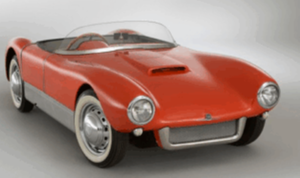
The car was designed exclusively for major rally circuits.
Built on an advanced box-section aluminum chassis, it used a 3-cylinder engine from the 93, modified to deliver 57.5 hp compared to the standard 33 hp.
The result was a winning combination of light weight and high strength.
The body was made of fiberglass-reinforced plastic, an innovative material at the time, and the complete car weighed just 500 kg (1,100 lb).
With a top speed of 160 km/h (about 100 mph) and capable of covering a kilometer in 36 seconds from a standing start, the new model was more than a match for its competitors.
Equipped with a hard top and a 4-speed transmission, it could reach 180 km/h (112 mph).
The initial series consisted of 6 cars, and the model was entered in several track competitions.
However, rally rules were later changed to allow modified production models to compete, making the older 93 suddenly competitive again.
Two of the six original models are now exhibited at the Saab Museum.
Three are owned by collectors, while the sixth was destroyed in an accident.
That same year, Middle East tensions, culminating in the Egyptian blockade of the Suez Canal, led to the first global oil crisis.
The previous year, Saab engineers had modified the Saab 92B to run on coal gas, using an improved version of the old Svedlund gas generator developed during the war.
In its modified form, the 92 could reach a top speed of 70 km/h (43 mph).
According to Len Lonnegren, Saab’s PR manager from 1963 to 1989: “The typical Saab customer was a technically inclined, detail-oriented person who appreciated the car’s mechanics. Many came from engineering backgrounds or were small business owners or professionals. They read Popular Mechanics. And they were all very enthusiastic.”
A 1957 customer survey revealed that doctors made up the largest customer group, followed by sales managers and aerospace industry employees.
A significantly large group of amateur pilots ranked fourth.
Another survey, conducted about two years later, showed the most numerous group to be highly educated professionals: doctors, lawyers, engineers, and university professors.
In 1958, Saab signed an agreement with Sud-Aviation in Paris to build and sell the Alouette II turbine helicopter. The first Swedish-built Alouette II made its test flight in May 1959.
Two aircraft had been built in less than a month.
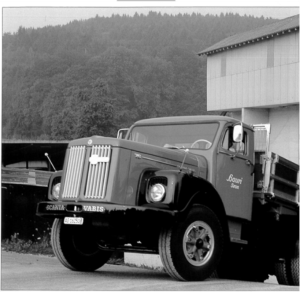
When Scania-Vabis launched the 75 series in May 1958, it could hardly have imagined that it would become its longest-lasting model.
Later renamed 76, 110, and 111 over the years it became more comfortable, more powerful, and heavier (although aesthetically it changed very little), and it remained in production until August 1980.
The truck was initially built in two-axle (L75) and three-axle with an auxiliary axle (LS75) versions.
Starting in August 1958, a three-axle version with tandem drive (LT75) was also offered. The gross weight ranged from 12.6 to 22 tonnes. The basic transmission had five gears, or ten with the optional auxiliary gearbox.
The new model was a modern heavy-duty truck that met the post-war market requirements, especially in terms of engine power and comfort. It was powered by a new six-cylinder direct-injection diesel engine producing 165 hp, and from February 1961 onward, by Scania-Vabis’s first turbocharged engine, delivering 205 hp.
In 1959, Scania-Vabis, with five years of experience in integral construction and backed by its popular BF73 chassis (from 1956), introduced its first integral bus: the CF75, also available in a CF65 version with lighter axles. At the same time,
new diesel engines for trucks and buses were launched, marked with the suffix “5*.
The CF65/75 chassis was essentially based on the BF73 (or BF65/75 as it was then known) but was lower and significantly lighter, being welded to the body structure to form a monocoque.
The exterior panels were made of aluminum or, for complex shapes, fiberglass-reinforced plastic.
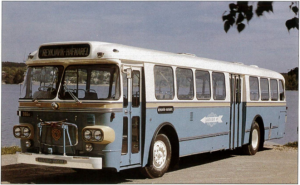
In 1963, with the introduction of the 11-liter engine, the models were renamed CF66 and CF76. Production was halted in 1966, when the plant’s capacity was needed for the construction of the new CR76 urban bus.
In May 1959, after ten years as a car manufacturer, Saab expanded its range by introducing a station wagon model: the Saab 95.
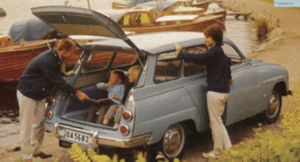
The first examples of the 95 were built with a curious mix of components — at the time, the best available to the designers — including the 841 cc engine and 4-speed transmission developed for the yet-to-be-introduced 96, as well as the wind-opening doors and dashboard from the 93.
A van version was also produced, with no rear seats or rear side windows.
In autumn 1960, Saab unveiled its third model to the press: the Saab 96.
It remained a “classic” Saab.
Although the front design remained unchanged, the rear half of the car was completely redesigned.
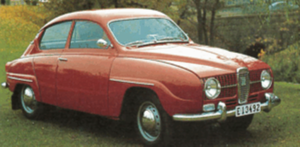
In 1965, the car was lengthened by 15 cm.
In 1962, the development of a new series of integral buses with a rear-mounted engine began, intended to replace the Capitol models.
The concept of a “standard bus” was introduced, which was essentially the specification for a comfortable and convenient urban bus for passengers. Since it seemed a feasible and realistic proposal, it formed the basis of the new Scania-Vabis CR76.
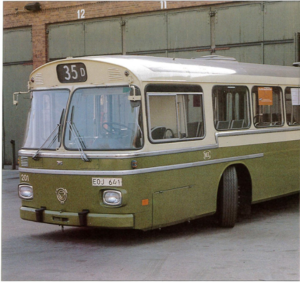
Two dominant factors were reduced weight and a low floor.
To achieve a lower floor, the engine obviously had to be mounted at the rear.
The 76 Series, presented in January 1963, was produced for five years, during which various innovations were introduced.
The power of the standard and turbocharged engines was increased to 190 and 260 hp, respectively, and the gross weight was also increased. The braking system was divided into two circuits for greater safety.
In addition, since it was equipped with pneumatic power steering, the parking brake served as a third emergency braking circuit.
In 1967, power steering became standard.
An important technical innovation introduced in 1964 was the combination of the main and auxiliary gearboxes, creating a ten-speed unit that was 50 kg lighter and less bulky than the original “five plus two” configuration.
In 1966, the Scania-Vabis driver’s cab was introduced. Although very similar to the Be-Ge version, it was entirely made of steel.
This was the L36 cab, a “normal” cab now also available in a longer version with a sleeping and resting area.
The section between the cab and the engine had been modified — one of the very few external changes made in twenty-two years.
Scania-Vabis built more than 38,600 units of the 75 and 76 Series, a total that, together with the 110 and 111 Series, would be tripled before production of this long-lasting model was discontinued.
1960–1969
Scania-Vabis continued its international development. In 1964, a large assembly plant was opened in Zwolle, the Netherlands. That year, Scania-Vabis’s turnover exceeded 1 billion kronor for the first time, with over 60% of production exported. Other milestones in the company’s history included the production of 10,000 vehicles in 1965, a workforce of over 10,000 employees, and the delivery of the 100,000th truck in 1966.
The company began producing its own cabs in Oskarshamn, and bus production was transferred to Katrineholm.
The “Scania Program” was launched, and the decade ended with the merger with Saab, forming Saab-Scania.
The 1967 Saab 96 was the first to be equipped with the new German-made Ford V4 four-stroke engine, producing 65 hp, with secret tests conducted in Desenzano, Italy by Rolf Mellde.
A new anti-theft feature required the gear lever to be in reverse for the driver to remove the key.
The most talked-about innovation of 1964 was an extremely rare safety feature at the time: a dual independent braking system. Saab’s setup was unique, with the two circuits arranged diagonally: one operated the front left and rear right, the other the front right and rear left.
If one circuit failed, the car still had braking power on two wheels, keeping it straight and reducing skidding risk.
Production of the 96 ended in late 1979.
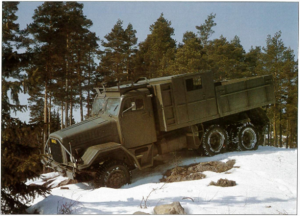
Scania called it the LA82, but for the Swedish armed forces, it was the Ltgb 957, and for the soldiers it was simply known as “The Anteater”, a nickname given because of the elongated and sloped shape of its front.
The first Anteater, an almost entirely new model, was delivered to the army in 1960. With a curb weight of around 11 tonnes, it was one of the largest trucks ever built in Sweden.
In 1960, motorsport enthusiasts welcomed with great enthusiasm the new experimental racing car built under Formula Junior regulations, which specified that all essential engine and chassis components had to derive from a production model of the same type.
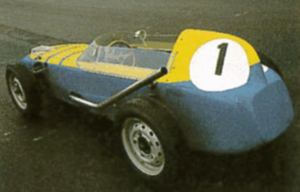
In 1961, Saab received an order from the Swedish Navy for the construction of an untested amphibious vehicle known as the Hovercraft (Saab 401), designed to operate on land, ice, and water. It was tested in 1963.
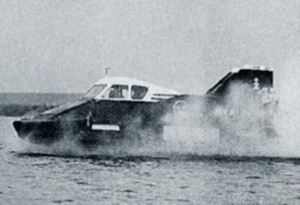
In the same year, Saab introduced seat belts as standard equipment in its cars—long before they were legally mandated.
In 1963, Saab built its 200,000th car, delivered the first Falcon missile, and began testing the Saab 105 Sk 60, an aircraft for training, light attack, reconnaissance, and personnel transport, originally designed in 1960.
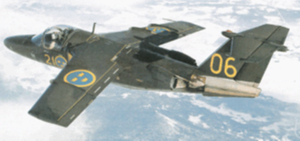
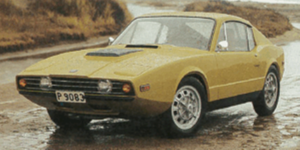
In 1966, the first Sonett II was unveiled in Stockholm.
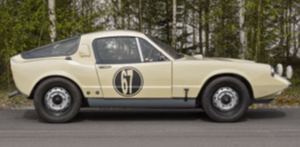
Thanks to the complete front opening, the car was exceptionally easy to maintain
. Equipped with triple carburetors, the engine (derived from the Saab 96 Monte Carlo) produced 60 hp.
It used a two-stroke engine, later replaced by a new four-stroke V4 engine introduced in the 96.
This change resulted in an unsightly bulge on the hood.
The Sonett III was redesigned by Swedish designers and Italian Sergio Coggiola.
In 1964, Saab developed the RB08 missile, and under the leadership of Ove Hammarström, engineers from Saab (in collaboration with Asea and LM Ericsson) began working on a satellite for scientific research.
The project was conducted under the auspices of the European Space Research Organization (ESRO), with the launch scheduled for 1967.
In 1965, although commonly known as Saab, the company officially changed its name to SAAB Aktiebolag.
In 1967, the Saab 99 was introduced.
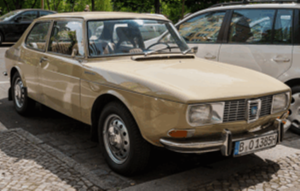
Nicknamed “Toad,” the first “Gudmund prototype” appeared on Swedish roads in 1966.
It featured a widened 96 body mounted on a 99 chassis—perfect for hiding the transition from the two-stroke, 3-cylinder engine to the new four-stroke, 4-cylinder unit.
Because new designs had to be road-tested with a complete chassis, the “Toad” was built to mislead the curious press.
Despite skepticism, Saab finally abandoned the two-stroke engine, with the modified Ford V4 engine quickly proving successful.
On November 22, 1967, the Saab 99 was officially presented to the press in Stockholm.
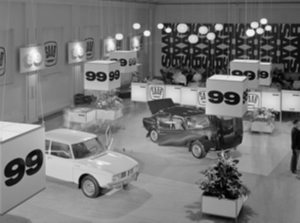
The car became available to the public in fall 1968 as a 1969 model.
In a feature article, Car and Driver wrote:“Saab doesn’t build automobiles—it builds Saabs, vehicles that offer a highly distinctive and particularly logical solution to one of man’s transportation problems.”
The Saab 99 sold 19,411 units in Sweden in its first production year, placing fifth in new registrations.
In 1972, Teknikens Värld named it Car of the Year, citing:
“This award recognizes the attention to detail, which puts it in a class of its own.”
Innovations included a rear-placed ignition between the front seats, and shock-absorbing bumpers made from plastic blocks with “memory.”
Impacts at low speeds (up to 5 mph) would not damage the car or its bumpers.
Another notable feature introduced in 1972 was the electrically heated driver’s seat.
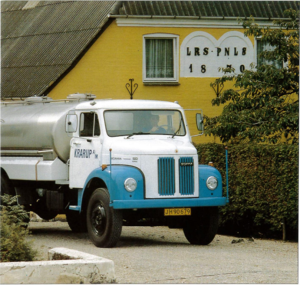
In February 1968, the L50 series was launched.
The L50 model could be considered the last “light” truck built by Scania (while still allowing for possible future developments). This 12-ton truck was the smallest in the new series and was presented alongside the larger 80 and 110 models.
Not entirely new, the L50 was essentially an improved version of the L36, which had been introduced in autumn 1954.
However, it featured a new type of front axle, and in June 1971, it was also equipped with spring brake chambers, a new (and much appreciated) feature of the Scania series. Instead of the conventional handbrake lever, the parking brake on the “new” model was engaged via a small lever located on the dashboard.
At the end of 1968, the boards of Saab Aktiebolag and AB Scania-Vabis (renowned for trucks and buses, with a diesel engine developed in 1936) decided to merge, forming Saab-Scania in 1969.
Thus, Saab-Scania was founded in 1969.
In June 1969, Scania-Vabis began building a turbocharged V8 direct-injection engine for its new LB, LBS, and LBT140 Super trucks.
Capable of developing 350 hp, the new unit allowed Scania to take the lead in the race for higher-power engines among European truck manufacturers and represented a significant improvement over the 260 hp 11-liter inline-six.
While the demand for more powerful engines was encouraged by higher gross weights and axle loads permitted by advances in road construction, there was also an international demand for trucks that could adapt more efficiently to traffic conditions, with improved speed and acceleration performance.
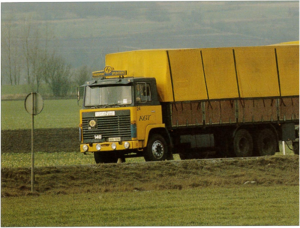
For several years, Scania had been testing a V8 engine, as it was better suited for the even greater power that would be needed in the future.
The 14-liter displacement offered greater potential for continuous development, while the V8 configuration created a compact unit that did not occupy too much space under the forward-control cab.
The turbocharging system, which Scania had developed in the 1950s, decades before it was widely adopted by the automotive industry, now became standard.
With a maximum speed of 2,300 rpm, the first generation of Scania V8 engines produced a maximum torque of 1,225 Nm at 1,400 rpm.
A new type of turbocharger was used to supply both cylinder banks.
To mix fuel and air more efficiently, five-hole injectors were introduced, and for the first time, the injection pump included a smoke limiter.
The LB140 model featured the same new tilting forward-control cab introduced a year and a half earlier (in February 1968) with the LB110.
Lionel Sherrow, the English cab designer, created a completely Scania-Vabis look, while also improving interior comfort.
The LB110 and LB140 models contributed significantly to the success of Scania-Vabis exports in the late 1960s and early 1970s.
In February 1968, the LB110 replaced the LB76.
The Scania LB110 came standard with a ten-speed gearbox.
1970–1979
This decade was one of expansion, with production doubled and exports tripled. Exports accounted for 83% of production, surpassing 10,000 units in 1970 and 20,000 in 1979.
A new plant was opened in Tucumán, Argentina.
Key milestones:
1974 – over 5,000 separate engines
1978 – over 2,000 buses
1979 – more than 20,000 employees
1979 – 1 billion kronor in profits
The Scania Division began building petrol engines and gearboxes for Saab cars.
In 1964, there was a first meeting between Scania-Vabis and FMV (the Swedish Defense Materiel Administration) for the supply of a new off-road vehicle.
In 1969, an order was placed, and the first two prototypes, the Scania LBA110 and LBAT110, were delivered a year and a half later.
After summer and winter testing, in wet and cold conditions, on the most difficult terrain imaginable, and after the production of another series of prototypes, deliveries to the armed forces began just before Christmas 1975.
The trucks were designated SBA111 and SBAT111.
These vehicles were designed to operate in extremely difficult terrain, able to climb slopes of 60% and carry a full load on a lateral slope of 40%.
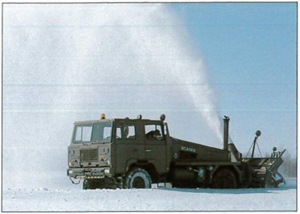
The trucks were available in two versions: The SBA111 was equipped with a 220 hp six-cylinder Scania D11 diesel, had two axles, a payload of 4.5 tons, and could tow a 6-ton trailer off-road.
The SBAT111, with three axles, had a 300 hp supercharged DS11 engine, a 6-ton payload, and could tow 12 tons.
Both models were all-wheel drive.
2,700 SBA111/SBAT111 units have been delivered to the Swedish army, remaining in service until 2020!
Another 700 were exported, and special versions were also built.
Between 1977 and 1979, the Swedish Air Force purchased 80 SBA111 units as snowplow vehicles.
The CR145 engine, at its debut in 1971, was described as “something very special.”
Mounted transversely at the rear, it was the naturally aspirated version of the turbo V8, considered the most powerful truck diesel in Europe: Scania’s first 14.2-liter V8. Its 260 hp was quite unusual for a bus!
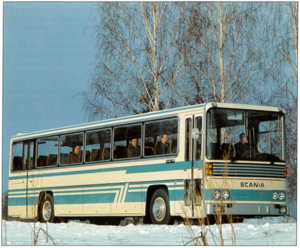
In 1974, the Scania L111 was introduced.
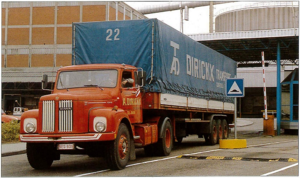
The L111 model had more powerful engines producing 203 and 296 hp.
In May 1977, customers could also choose an optional 305 hp unit. Meanwhile, the gearboxes were developed and refined.
When production of the 75, 76, 110, and 111 models was discontinued in August 1980, this series had established a production record of over 115,000 units, difficult to surpass.
The trucks were produced in Scania plants in Sweden, the Netherlands, Brazil, and Argentina.
More than 23,000 units were sold domestically, where the most popular version was the three-axle LS with a single drive axle, while abroad, the two-axle L model was more popular. The LT three-axle model with tandem drive was extremely rare in Sweden, where only 526 of the 15,000 built were sold over 22 years.
L111 production reached a total of 30,150 units.
Production of the L140 and LS140 bonneted models began in February 1972, two and a half years after the forward-control version.
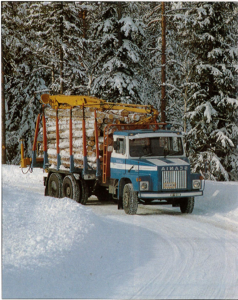
Since timber transport companies traditionally preferred bonneted trucks (as having the engine in front gave a sense of security on narrow, icy forest roads), the new L models became popular in this sector. They were also widely used for construction, heavy transport, and even towing.
In 1975, Scania introduced a tandem-drive version of the L140 for heavier applications, called the LT145.
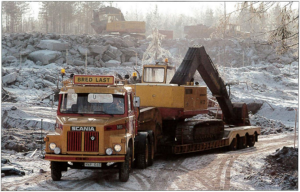
The growing trend of decorating trucks with paint, interior accessories, and chrome trim made the L140 model highly sought-after.
In 1975, a van version based on the combi coupé body was introduced, later called the “99 Van.”
The usual program of development and improvement undergone by the model in the following years culminated in significant progress with the launch, in 1977, of the Saab 99 Turbo, a project naturally shrouded in a formidable veil of secrecy.
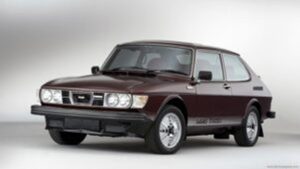
The car brought a breath of fresh air to the automotive scene and left an indelible mark on anyone who had the chance to sit behind its wheel.
Its 2-liter, four-cylinder turbocharged engine produced 145 hp, a revelation in 1978, especially compared to the BMW 320i with just 105 hp.
This car helped spark the turbo revolution in the auto industry.
The 99 Turbo Rally, unveiled on January 16, 1978, boosted engine power to 240 hp and torque to 369 Nm (273 lb-ft) at 3,500 rpm.
Saab withdrew from racing in 1980 due to regulation changes that allowed special cars built in limited numbers.
Introduced in 1974, the Combi Coupé combined the elegance of a sedan with the spaciousness of a station wagon.
In 1985, the model was so extensively modified that it was renamed the Saab 90,
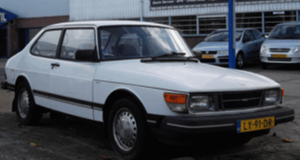
adopting the rear design of the Saab 900 Sedan and being compatible with unleaded fuel.
Work on the Saab 37 Viggen, the successor to the Draken, began as early as 1952.
First flown in 1967, the multi-role aircraft was designed for attack, training, reconnaissance, and interception.
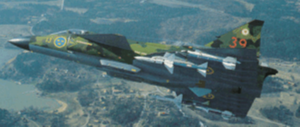
It could be prepared for its next mission in 10 minutes by five conscripts under a technician’s supervision.
Scania launched new products in 1969, including the LB80, 85, and 140 trucks, and the Metro-Scania bus. The 140 was the most powerful road vehicle in Europe at the time, with a 350 hp Scania DS 114 diesel engine.
The 1969 merger prompted a reorganization into four divisions:
1. Automotive Division – focused on environmental and safety improvements.
2. Aerospace Division – focused on aircraft like the Viggen and Draken.
3. Computer and Electronics Division – responsible for control systems and computers for industry and defense.
4. Nordarmatur Division – specialized in instrumentation for industrial and power plant applications.
In 1971, Saab-Scania joined a consortium with BAC, MBB, and CASA to develop the Europlane, a commercial airliner.
Though never completed, the project contributed valuable experience later used in the SF340.
In 1971, Saab-Scania formed a consortium with British Aircraft Corporation, Messerschmitt-Bölkow-Blohm, and CASA (Spain) with the aim of developing a commercial airliner called Europlane. Although the project never materialized, the studies provided valuable experience that was later applied to the design of the SF340.
In December 1971, Saab-Scania signed an agreement with the government to undertake the joint development of telecommunications and meteorological satellites. At the same time, in Australia, the European Space Research Organization launched a space probe equipped with equipment designed and manufactured by Saab-Scania.
In 1968, when Saab acquired Malmö Flygindustri (MFI), the Swedish Air Force was looking for a successor to the Sk50 Safir trainer aircraft, and the Army was planning to replace the Piper L-21Bs used for artillery observation and liaison operations.
At the time, MFI was developing an aircraft that made its maiden flight on July 11, 1969, which appeared to be ideal for both purposes.
It was the Saab MFI-17 Safari / Support.
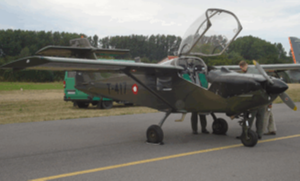
In 1972, Saab-Scania launched satellites for northern lights studies and collaborated on the TD-1A launched from Vandenberg AFB.
Saab also began experimenting with steam engines and anti-lock brakes (ABS), the latter becoming standard 14 years later.
The Saab 98 was an attempt to bring the combi coupé concept to the 95/96, but never entered production.
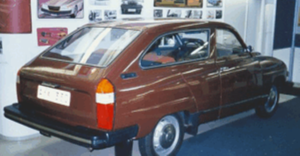
In 1969, Scania-Bussar formed a joint venture with the British coachbuilders Metro-Cammell Weymann Ltd (MCW). The MCW designers traveled to Katrineholm to study the monocoque construction, and the prototypes were tested on Scania’s vibration test track. The first eighteen single-deck Scania BR111 vehicles with MCW bodywork and Scania mechanics (BR110) were delivered in March 1971.
The body was a monocoque, identical to the Scania CR110, and the layout of the chassis components was the same.
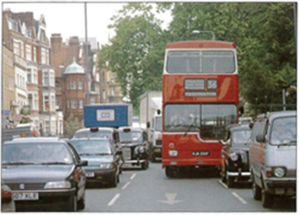
Scania and MCW jointly decided to build a double-decker bus. Named BR111 DH, the chassis was largely based on the standard components of the BR111.
Between 1971 and 1978, MCW received a total of 133 single-deck BR111 chassis and 663 double-deck BR111 DH chassis (including 164 for London Transport), while others were exported to other countries, including Hong Kong.
The Saab 99 Turbo made its public debut at the 1977 Frankfurt Motor Show.
Saab was the first carmaker to adapt a turbocharger for mass production cars.
Scania had first used turbocharging in 1951 in rail buses and trucks.
Shortly afterward, the engines were also used to enhance the performance of trucks.
Technological improvements led to the introduction of the first turbocharged car in 1977, the Saab 99 Turbo.
Fearing an impending crisis, the work on the 99 was accompanied by the design of a new model based on the 99 hatchback..
However, the new version was so different that it required a new model designation.
In 1978, the Saab 900 debuted.
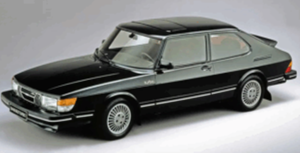
The bodywork, completely new, was designed by chief designer Björn Envall from the Trollhättan design department.
It featured a deeply curved windshield, much more steeply inclined than those found on most cars of the time, reflecting the brand’s aeronautical heritage.
The “combi coupés” were exceptionally spacious, and further emphasizing their aeronautical origin, the dashboard of the Saab 900 was curved to allow easy access to all controls.
Saab engineers positioned all the controls and indicators on the dashboard based on their frequency of use and/or importance, so that the driver would have to take their eyes off the road for the shortest possible time and at the smallest possible angle.
This is why the frequently used radio is positioned so high up in the dashboard. The steering column was telescopically collapsible thanks to deformable steel bellows. In the event of a collision, the steering wheel would retract away from the driver to minimize the risk of chest and head injuries.
By the late 1970s, the Scania truck range was based on seven core models. With all possible combinations, however, approximately 10,000 variants could be produced—a rather curious statistic highlighting the ability to adapt each vehicle to virtually any type of use.
The LB81 model was the smallest cab-over truck in the new “Scania Program” series introduced between 1974 and 1976. It was essentially identical to the LB80 model it replaced. The LB81 featured a slightly smaller version of the forward-tilting cab introduced on the LB110 in 1968.
The interior of the new version included various modifications, such as an improved driver’s seat with electric heating.
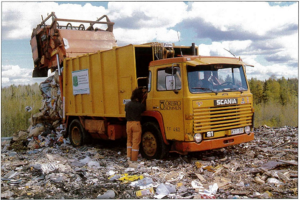
During the 1970s, traffic in major Swedish cities grew increasingly intense, and restrictions on truck length and other regulations were imposed. Meanwhile, socio-demographic developments demanded faster and more efficient goods distribution.
It became necessary to create a compact truck with a high payload. Oil companies and other distributors needed a model capable of carrying heavy loads without a trailer, maximizing the tonnage transported per trip while minimizing operating costs.
The solution was the LBFS111, Scania’s first four-axle truck.
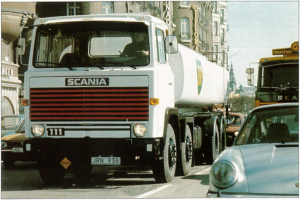
The LBFS111 was one of Scania’s most unusual trucks. Between August 1978 and November 1980, only 39 units were built, of which 22 were for export.
In 1974, Scania introduced the 111 series, which succeeded the 110.
The 11-liter engines offered greater power, lower fuel consumption, and reduced emissions.
The V8 engines, introduced in 1976 with the 141 and 146 models, shared the same characteristics.
The DS14 had a rated power of 375 hp, an increase of 25 hp, once again making Scania the leader in the heavy standard truck sector, while the LT146 with
tandem drive (now with a total weight of 30 tons) was even more suited for heavier-duty operations.
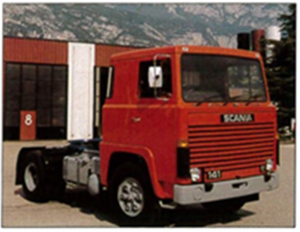
Italy became one of the markets where Scania established itself, aided by the 141 model.
With the easing of EU import restrictions and showing confidence in the brand, Armando Rangoni, a Fiat dealer from Trento, founded Italscandia in 1974. By giving up the Fiat representation, Rangoni secured exclusive import rights for Scania vehicles in Italy, beginning a profitable partnership.
By 1990, the 20,000th truck was delivered in Italy. In 1991, Scania ranked second in the Italian heavy truck market, closely following Iveco, the national brand.
Lapiana of Trento was one of the first customers served by Armando Rangoni during the formation of Italscandia.
Founded in 1971 for food transport, it has since become an international transport company. With a fleet of 52 Scania vehicles, Lapiana (now ceased) transported a significant portion of Italian food exports to Northern Europe.
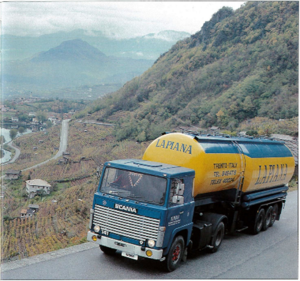
With a fleet of fifty-two Scania vehicles, Lapiana (now ceased) transported a large portion of the food products exported from Italy to Northern Europe.
1980–1990
During this decade, Scania became the fourth largest heavy truck manufacturer in the world. Revenue increased from 8.2 billion to 24 billion kronor, and profits
rose from 1.4 billion to 3.8 billion kronor. Exports exceeded 90%. Bus production reached a record of 3,800 deliveries in 1989.
In 1987, for the first time, over 30,000 vehicles were produced, and two years later, this number was exceeded by truck exports alone.
Production of engines and gearboxes for Saab cars was discontinued following the GM–Saab merger.
In 1988, VW vehicle sales reached 46,240 units, the highest since 1965.
In 1980, Scania introduced the first models of an entirely new truck series, with model numbers ending in “2,” presenting the T82, T112, and T142.
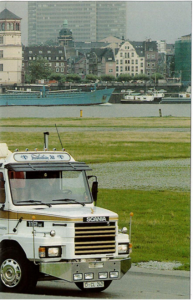
The main characteristics of this series were the high level of component standardization and the comfort offered by the bonneted models.
Three types of chassis were available: M (medium-duty), H (heavy-duty), and E (extra-heavy-duty), with gross weights ranging from 16 to 36 tons.
Other innovations included a new generation of engines with higher power and torque, providing lower fuel consumption and cleaner exhaust emissions.
In 1981, the 82, 112, and 142 cab-over models were added, all featuring the basic elements of Italian-designed cabs with their modern standard of comfort. The base cab of each version was simply modified by adding rear panels, side panels, doors, and bonnets of different heights, using the letters G, P, and R to denote cab size.
With the GPRT range, Scania made greater progress toward rational component standardization than any competitor.
The Series 2 introduced intercooled turbocharged diesel engines, a “third generation” of diesel technology.
The first of these engines was an 8-liter unit, followed a year later by intercooled versions of the 11- and 14-liter engines.
Cooling the compressed air from a turbocharged engine allowed higher power output without increasing fuel consumption or emissions.
The T112 had a 333 hp six-cylinder inline engine with intercooling and a ten-speed gearbox. It was often used as a tractor for medium-range heavy semi-trailer transport, where the extremely high power of a V8 was not required.
The 1982 Saab 900 Turbo was the first model to be equipped with Automatic Performance Control (APC), a system that automatically adjusts engine performance according to the fuel’s octane rating.
The APC (Automatic Performance Control) is a feature that allows the vehicle to use fuel with an octane rating between 92 and 98.
Developed by Saab-Scania, the system consists of an electronic control unit that receives signals from three sources: the distributor, a knock sensor on the engine block, and a pressure sensor in the intake manifold.
As soon as knocking is detected, the control unit instructs the turbo to reduce boost pressure, eliminating the risk of engine damage.
The Saab 900 Turbo 16 was the first model to be equipped with this system.
This advancement attracted significant international attention.
In 1982, the German automotive organization AvD awarded Saab the prize for “the most important contribution of the year to safety,” referring to one of Saab’s features from that year: the part of the rearview mirror closest to the body is almost flat and is separated from the outer part, where the glass is convex to provide a wider field of view.
Few believed that Saab-Scania could balance its military and civilian activities before the end of the 1980s.
A similar situation occurred in the missile sector, where several major projects had been abandoned and some personnel reassigned.
At this point, however, Saab-Scania was fully committed to the sector, and all available resources were focused on the RBS15 anti-ship missile.
Although the Saab automotive division had improved compared to the previous year, the entire operation was still running at a significant loss, mainly due to the substantial resources spent on the development of the Saab 900.
In the automotive sector, Saab-Scania moved toward specializing in exclusive models that offered high standards of innovation, comfort, and safety, high-level performance, and low fuel consumption.
This event marked the triumphant entry of the Saab 900 Turbo into the global market.
The agreement with Lancia was extended to include the development and production of a completely new range of automobiles for the 1980s. (Saab had been involved in the development of Lancia’s latest model, the Lancia Delta, which was sold in Sweden as the Saab-Lancia 600.)
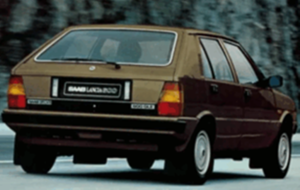
Saab and Fiat signed an agreement that allowed the Lancia Delta to be marketed in Sweden and Norway in 1980 under the name Saab 600. However, its bodywork suffered from serious corrosion problems, so it was no longer sold after 1982.
By the end of the 1960s, Sweden had become the second country in the world (after the Soviet Union) to equip its naval forces with surface-to-surface missiles.
The RBS15 can also be used for coastal defense.
The missile can be launched from autonomous batteries or used as an integral part of an overall defense system.
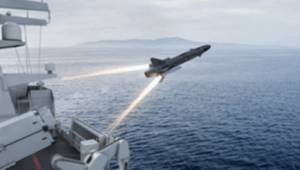
With a weight of 780 kg (1,720 lb), including boosters, the RBS15 is 4.35 m (14’3”) long and has a diameter of 0.5 m (1’7”), with a wingspan of 1.4 m (4’7”).
With a range of over 70 km (43 miles), this weapon nearly quintuples the offensive reach of the ship.
In 1986, Saab Missiles (founded in 1983) received an order to develop a mobile coastal defense version of the RBS15, confirming the Swedish Armed Forces’ ‘weapon family’ philosophy in the context of strategically important systems.
In 1980, Scania introduced an entirely new range of cab-over-engine trucks with a GVW (gross vehicle weight) between 16.5 and 36 tons. The design was based on a modular system that allowed vehicles to be built by assembling various combinations of components to meet specific transport requirements.
Scania-Buses used the most powerful engines available, while the strong yet lightweight chassis offered excellent driving characteristics for incorporating them into the new range introduced in 1982. The evolution of the BR116 led to the K112 (or K82 with an 8-liter engine). Efforts were made to maximize the standardization of components between trucks and buses in order to create a “global” model that could be sold, without difficulty, alongside trucks even in less developed countries.
The success was immediate. The model quickly became a best-seller and went on to become the most successful Scania bus chassis of all time.
In 1984, the K82 was followed by the K92, equipped with the new 9-liter Scania engine. The K112 was also available, with the option of an 11-liter engine with intercooling. Developing 333 hp, this model was ideal for long-distance applications.
In 1988, a new series of chassis, Series 3, was introduced.
The K92 and K112 became the K93 and K113, developing a maximum power of 363 hp, and the large air-cooled, low-emission DSC11 engine was also included.
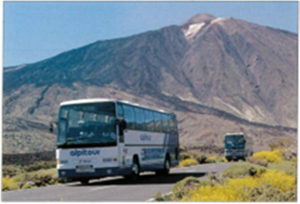
In 1981, the Swedish Space Corporation approved the first Viking satellite of Swedish design, and production began with Saab-Scania as the main contractor. A contract was also signed with the company for the development of design specifications for a communications satellite.
The first launch test of the RBS15 was also carried out, with results described as “completely positive.”
The commuter airliner project had already led to the development of a model known as the Saab-Fairchild 340.
Time was running out: the first aircraft had to be presented in November 1982, followed by the first deliveries in 1984.
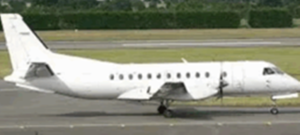
Derived from a military helicopter engine, the General Electric CT7-5A used in the SF340 is considered one of the most tested, economical, and easy-to-maintain power units available.
The SF340’s maiden flight took place on January 25, 1983.
Only seven simple tools are needed to disassemble and reassemble the engine.
The first aircraft was unveiled on October 27, 1982, during an impressive signing ceremony officiated by King Carl XVI Gustaf.
And on January 25, 1983, exactly three years after the agreement with Fairchild was signed, the SF340 made its first flight.
The first customer was the Swiss airline Crossair, which introduced the aircraft into scheduled service on June 14, 1984. The first passenger was Pope John Paul II.
In 1982, the Scania Division introduced two major new products: the 142 H intercooler engine with 309 kW (420 hp).
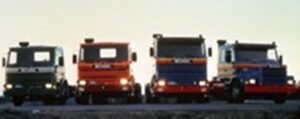
the most powerful standard truck engine in Europe, and a new generation of rear-engine buses for intercity and tourist transport.
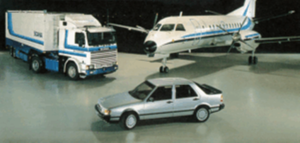
Saab Space produced telecommunications networks and control systems, computers, and other equipment for several joint European satellite and rocket programs, such as the Tele-X satellite.
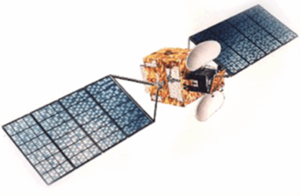
On February 26, 1986, the Viking satellite was launched from the Kourou Space Center in French Guiana aboard an Ariane rocket.
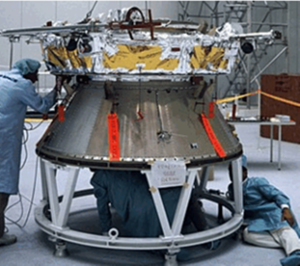
The Logo Adopted Upon the 1969 Merger

symbolizes the Saab-Scania Group as a whole.
The Group’s long tradition as an automobile manufacturer is represented by the legendary griffin.
Vabis produced its first factory-made car in 1897, while the griffin first appeared on a Scania vehicle in 1901.
The space band symbolizes the company’s modern, high-tech profile.
The design was created by Carl Fredrik Reuterswärd, who commented:
“The symbol consists of a circle inscribed with two rings, transposed to form a cylindrical band and to create an impression of optical movement. Although
presented from their own perspectives, Saab and Scania are seen as a single entity.”
Scania is the Latin name for the Swedish province of Skåne, where Maskinsfabriks AB Scania was founded in Malmö in 1900.
The first car produced by the company proudly displayed the griffin taken from Skåne’s provincial coat of arms.
During its first 20 years as an automaker, Saab produced only relatively small vehicles.
However, the Saab 99—the first of the larger models—was introduced in 1967, laying the groundwork for the development of a more upscale, sportier image. This trend continued with the launch of the 99 EMS, 99 Turbo, and 900 models.
Well before the final phase-out of the 900, Saab recognized the need for a replacement model.
However, the complexity and cost of developing an entirely new vehicle proved to be prohibitive.
Fiat was also looking for a partner to reduce the cost of designing and launching new models, so the two companies joined forces, launching the project known as Tipo 4.
The idea was that the platform developed during the project would underpin four different vehicles: one Saab, one Alfa Romeo, one Fiat, and one Lancia. The cooperation agreement was signed at the beginning of 1979, and work began on the new cars.
The Alfa Romeo 164 was designed by Pininfarina, while the Fiat Croma, Lancia Thema, and Saab 9000 were all the work of Giugiaro’s Italdesign studio.
Initially, the partnership worked well, but over time, disagreements between the engineers led to friction, and in the end, very few components were interchangeable among the models.
By 1981, the partnership had simply fallen apart.
It is said that the cooperation ended when the crash test results were released.
By Fiat’s standards, the results were acceptable; according to Saab, they were “not acceptable at all.”
The truth is, Saab was focusing on the American market, concerned with the strict U.S. crash test regulations, while Fiat and Lancia were withdrawing from the American market and were content to meet the less demanding European standards.
Saab decided to go it alone with the Saab 9000.
The final product was thus different from Fiat vehicles, though it retained some component similarities.
For example, the doors seemed interchangeable at first glance.
However, because Saab included stronger side-impact protection inside the doors, they were not compatible with Fiat cars.
The Saab 9000 Turbo 16 was unveiled in May 1984, and the first customers received their vehicles during the winter of 1984–85.
The model successfully combined the practical benefits of a station wagon with the comfort of a sedan.
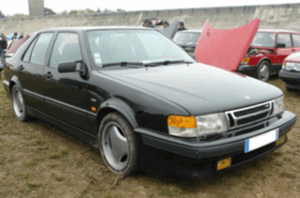
The 9000 was also judged to be one of the most spacious cars in the world among those tested under Swedish Autograph standards, which were recognized and applied internationally.
The 9000 represented an opportunity for Saab to introduce several innovations. In Saab’s direct ignition system, launched in 1988, a separate ignition coil capable of generating a 40,000-volt spark was mounted on each individual spark plug.
Three years later, in 1991, Saab became the first car manufacturer in the world to introduce an air-conditioning system that operated without traditional Freon.
In 1985, the concept car “Saab 900 Turbo EV-1” was unveiled — an experimental model by Saab-Scania. It featured front and rear impact protection made from composite materials.
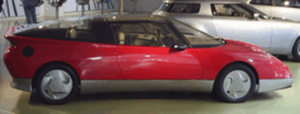
The car was taken to the track, and thanks to its aerodynamics, a curb weight of 1,150 kg, and increased power output, it reached a top speed of 270 km/h. Acceleration from 0 to 100 km/h took just 5.7 seconds, and it covered 1,000 meters from a standing start in only 24.8 seconds.
The JAS 39 Gripen prototype flew for the first time in 1988 and entered service in 1996.
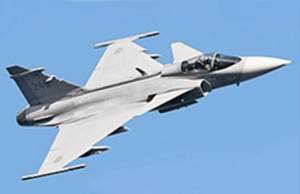
In 1986, the series production of the Saab 900 Cabriolet began at the Saab-Valmet plant in Finland.
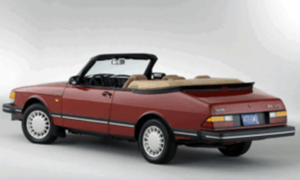
The production version was first showcased at the Chicago Motor Show, the largest event of its kind in the USA. Another development that year was the Saab 9000i, featuring a 2-liter, 16-valve engine with fuel injection, delivering 95.5 kW (130 hp), presented in Geneva.
That same year, Björn Envall wanted to create an open-top version to support the launch of the new Cabriolet.
To do so, he teamed up with Leif Mellberg, an independent coachbuilder and since the management refused to fund the project, the necessary financing was secured through the Swedish automotive magazine Teknikens Värld.
This two-seater roadster was based on the technical platform of a 900 Turbo 16 S, with the engine power increased to around 250 hp.
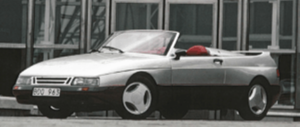
In the autumn of 1987, Scania introduced its Series 3, led by the R143.
After a few years’ pause, European truck manufacturers were once again competing to offer the most powerful models, all of which were described as “almost 500 hp.”
Greater power was needed not only to handle heavier tasks, such as forestry work and contracting jobs involving higher payloads, but also to meet increasingly strict schedules and the high average speeds required for long-distance transport.
Scania, with its glorious tradition in engine development, was at the forefront.
It was also the first European manufacturer to introduce a mass-produced diesel engine with electronic injection.
The R143, successor to the turbocharged engines with intercooling, marked the dawn of the electronic era, introducing technology already known from systems such as ABS brakes and electronically controlled automatic transmissions.
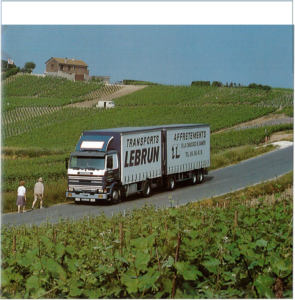
Scania G93 ML 4×2 1988
The Scania G model was nicknamed “Geisha” when the technical details of the new GPRT range were revealed in 1980.
Featuring an extremely low step for greater driver comfort, this model was ideal for deliveries where the driver must frequently get in and out.
For the first time, the new GPRT range offered customers the option to order cabins, chassis, transmissions, and suspensions suited to specific applications. For example, the P82 and the “light” G82 (16-ton gross weight).
The letter “G” designated the lower cab, which was paired with the Type 82 chassis or, from 1985 onward, the Type 92 chassis.
That year, Scania also introduced a new generation of its smaller engines by increasing the displacement of the 8-liter inline six-cylinder engine and equipping it with a new injection system, separate cylinder heads, and other mechanical improvements, resulting in a virtually new 9-liter engine with low fuel consumption, reduced weight, high efficiency, and low revs—all valuable characteristics in the delivery sector.
The new engine was available in turbocharged or turbocharged with intercooling versions.
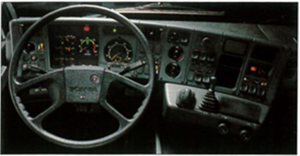
The curved dashboard of the G93 allows the driver to reach all controls more easily without needing to lean forward.
All-wheel drive offers significant advantages in difficult conditions, proving its superiority on soft ground, very steep and slippery slopes, and rocky terrain.
For example, on a construction site, conditions can be the worst imaginable, and the truck is usually the first vehicle on site.
It therefore needs to operate efficiently and profitably without getting stuck.
The new Series 3 included 4×4 and 6×6 models for such applications.
Based on Scania’s long experience in the military field, the all-wheel-drive trucks offer a level of mobility, economy, and load capacity that meets even the demands of the civilian sector.
The Scania P113HK 6×6 was available in versions with 310, 320, and 363 hp, all powered by a turbocharged six-cylinder engine.
The more powerful versions were also equipped with intercooling.
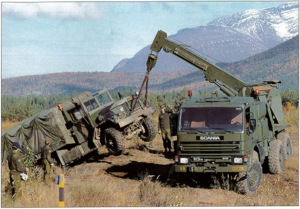
In March 1989, SAAB France launched the limited-edition Yacht Club based on the combi-coupé version, equipped with the new naturally aspirated 16-valve four-cylinder engine producing 133 hp.
In collaboration with the Yacht Club magazine, SAAB decided to celebrate the sponsorship by marketing a limited series of 70 units, distinguished by the Embassy Blue and Ultra Marine color tones.
A “Yacht – Club” decal was applied to the rear spoiler.
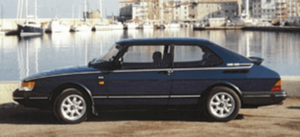
The maxi-catamaran Elf Aquitaine II, 20 meters long, with Marc Pajot as skipper and an impressive track record, was acquired by François Boucher in 1988.
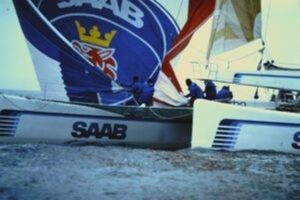
Sponsored by the Swedish manufacturer, it was renamed SAAB Turbo.
Finally, in the same 1989, General Motors acquired a stake in Saab Automobile AB, marking the beginning of the end for Saab-Scania.
Sources:
• Scania Parade 1891-1991- Steiffert 1990
• Gunnar A Sjögren – 1984 The Saab Way, Tryckeri AB, Sweden
• Saab Scania AB – 1987 The Saab Scania Story, Streiffert & Co., Sweden
• Anders Tunberg – 1980 From Two-Stroke to Turbo, Motor Racing Publications Ltd.
• Brian Williams – 2012 Saab: A Short Story, Salim Bouzekouk
• Aurélien Gueldry – Saab 900 Top Model, ETAI, 2021